6 Months with a Mito
Italian flair or despair – how has Alfa’s baby hatch stacked up over the last 6 months?
Words and images - Oli Hunt

A well-known motoring show once proclaimed that a person cannot be considered a true car enthusiast until they have owned an Alfa Romeo. Indeed, the scudetto has become synonymous with a driving experience that overflows with charm and character.
Having not yet ticked that box, and with the upkeep of my tired Rover 75 gradually becoming too much for me to justify, I decided my new daily driver would finally scratch the Alfa itch.
For all its talents, running the 75 had me craving something small and chuckable for a change. Enter stage, Mito.

The Mito was styled after its exotic stablemate, the 8C.
Entering production in late 2008 and continuing to roll off the production line for a whole decade, the Mito is a model that sparked controversy among many die-hard alfisti. Conceived alongside the Giulietta as the building blocks of one of the brand’s many rebirths, the Mito was built on the same core platform as the third-generation Fiat Punto, as well as the Vauxhall/Opel Corsa of the era. Because of this, many enthusiasts refused to consider the Mito a ‘true’ Alfa Romeo. Of course, ignoring that their beloved 155 owes its underpinnings to a Fiat Tipo. Oops.
Pitched as a premium supermini, the Mito had the second-generation BMW Mini in its sights. The little Alfa’s mechanical package was fairly innocuous at launch, hitting the market with a range of 1.4-litre petrol engines in varying states of tune, as well as a 1.3 and 1.6 turbodiesel. Its pièce de résistance took the form of a driving mode selector, known as the ‘DNA’ system. With this, the Mito was supposed to offer drivers a ‘Dynamic’ experience with a sharper throttle pedal, a more laid-back ‘Natural’ mode as well as a winter-friendly ‘All-Weather’ setting.
In reality, the Mito seemed to occupy a dynamic no-man’s land. While the Multiair engines were heaped with praise, the tactile experience of driving a Mito fast rarely seemed to excite quite like a Clio RS. With its bug-eyed face, the styling has always been divisive. You really do either love it or hate it. I personally find it quite cute – with its overexaggerated wheel arches and afterburner-style LED taillights, there is little else on the road for which it could be mistaken.
Having spent the past 6 months behind the wheel, though, I do believe this is a little car that was never quite understood.

Within just a few years of its launch, the petrol engine range saw the arrival of new ‘Multiair’ technology. With just one physical camshaft, the intake side of the engine uses a rocker arm to piggyback off the exhaust cam to receive its instruction. From here, the ECU tells the hydraulically actuated intake valves how much and for how long to open, essentially facilitating infinitely variable valve timing and lift. Clever, and complicated…
The upshot of all this is that these new engines are very adaptable to different driving scenarios, and are capable of producing more power over a wider rev range without sacrificing fuel efficiency or tailpipe emissions. Indeed, the then-new range-topping 170PS Cloverleaf achieved a claimed average of 47 mpg, not shabby for a hot hatch that could reach 60mph in just a hair over 7 seconds.
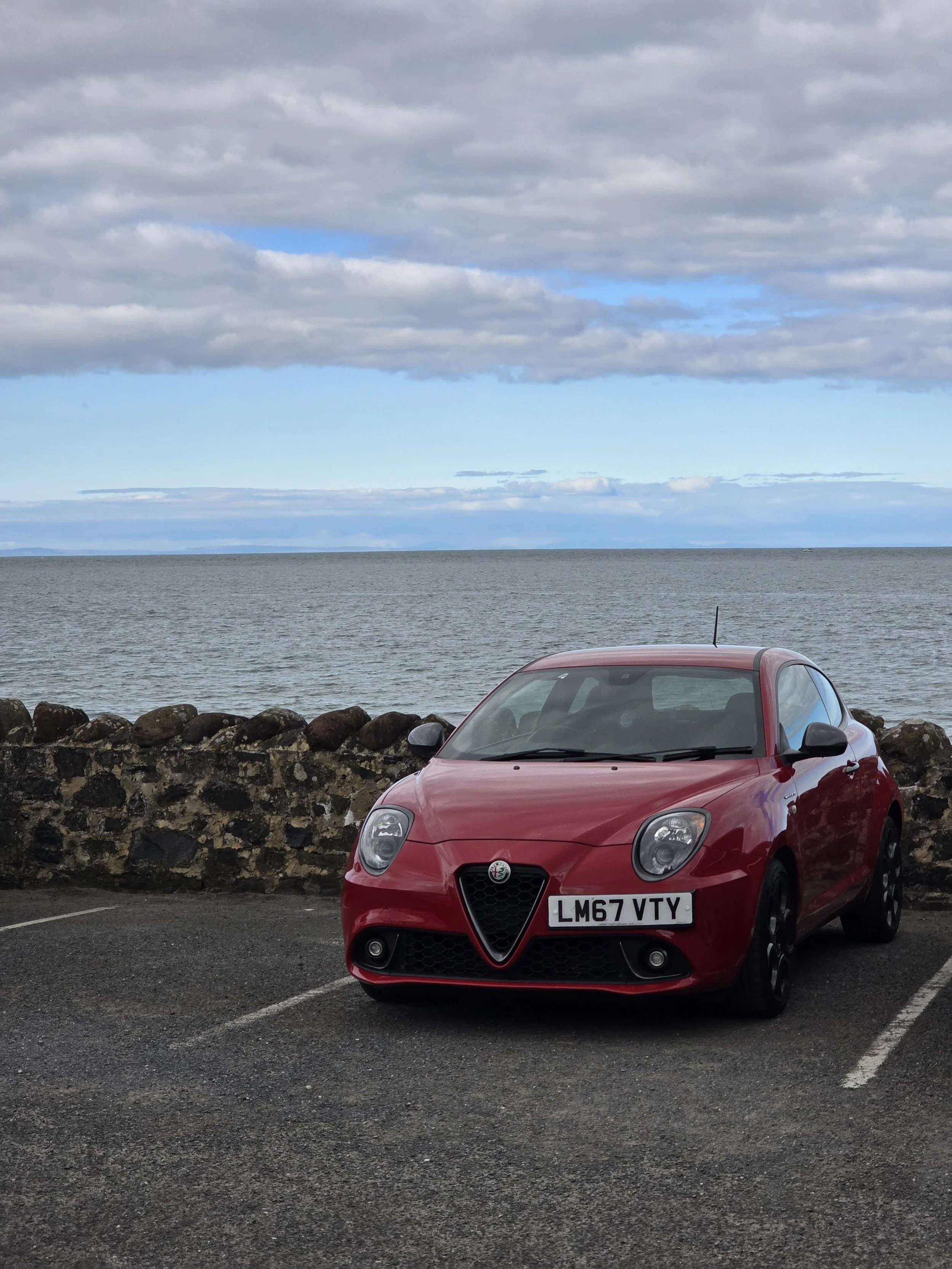
After searching for a number of weeks, the right car with all the right options appeared on my radar and I knew I had to have it. Finished in classic Alfa Red with the rare 18-inch ‘teledial’ style alloys, this late model example certainly had the visual flair to match the pedigree.
From 2016, when the facelifted Mito was revealed, the model range was shuffled around. The flagship Quadrifoglio Verde, having already been renamed from Cloverleaf, became known as the Veloce. Being a late model car, this 2017 Veloce comes with the 6-speed dual-clutch transmission which became standard fit in the UK market from 2014 onwards.
Collecting the car and setting off on the 300-plus mile drive home to Northern Ireland, I was immediately smitten. Despite the age of the design, there are a lot of interesting systems at play in these flagship variants which help transform the driving experience from the standard car. It took a while to get to grips with the transmission – having never driven a dual-clutch car before, there was a brief period of learning how to drive it as smoothly as the torque converter automatic I was accustomed to. What helps is to remember that fundamentally, this is a manual gearbox that looks after itself. What you do with your right foot tells the car how to engage the clutch, so a sensitive approach is welcomed if you want to make smooth progress.
Once mastered, though, the TCT makes a very good bedfellow for the grunty 1.4 turbo. When you want to have some fun, it more than makes up for its minor shortcomings in composure - flick the machined DNA selector forward into Dynamic really wakes up the transmission and throttle response, providing near-instant downshifts with a very pleasing tailpipe soundtrack when driven manually.

By the time I reached the ferry, the car looked like something fresh off a rally stage.

Getting acquainted with the east Antrim coastline.

Admiring the powerful stoppers, and those teledials!

Trusting a decade-old Alfa Romeo sat nav was my first mistake - always a source
of adventure…
While it’s no RS3, the Mito Veloce is a car that feels much faster than it would appear on paper. Even from low revs this engine feels incredibly willing and responsive, with a very flat torque curve that very rarely leaves you wanting more. It feels like an engine twice its size. When the going gets twisty, the Mito does not roll over. Engaging Dynamic mode sharpens up the chassis and the whole car begins to communicate more, courtesy of the adaptive dampers. Developed in conjunction with Magnetti Marelli, accelerometers mounted on the body shell and the front wheel hubs continuously evaluate the body movement and adjust the damping force at each corner to maximise comfort and stability depending on the road surface, driver inputs and which driving mode is selected. Dynamic mode also engages the simulated limited-slip differential. Branded Q2 like the mechanical locker on older hot Alfas, this is a less sophisticated system which brakes the inside wheel in order to redirect torque to the loaded outside tyre. It’s no substitute for a proper LSD, but it works well enough to hold the Mito on its line when accelerating out of slow corners. As soon as the front end starts to lose traction, the system quickly gathers up the one-tyre fire and the nose of the car perceptibly tucks in. Should you find yourself needing to scrub off speed in a hurry, the most potent Mitos are equipped with a seriously impressive set of anchors. 305mm vented front discs are squeezed by 4-piston Brembo calipers, but more impressive than the force of the deceleration is the ease with which it can be modulated. The brake pedal is weighted just right and the servo assistance isn’t such that the brakes feel overly grabby like in so many modern cars. My only gripe is that the factory spec pads could provide a bit more feel, but the fundamental braking hardware is not to be sniffed at.

Mito steering assistance varies greatly between different driving modes. In Natural there is an uncanny lightness to the wheel, and a noticeable dead spot around 12 o’clock. Dynamic slackens off the level of power assistance and raises the threshold at which the stability control begins to interject, but it has to be said that the steering feel is not a Mito strong point. When the 215-section tyres load up and you start leaning on the chassis you can feel the car trying to get through to your fingertips, and the steering effort certainly goes some way to making the nose feel confident, but you absolutely don’t get the kind of telepathic steering feedback that may be found in a hot hatchback of the 1980s or 90s.
Many publications criticised the electronic ‘interference’ baked into the Mito, but I have come to begrudge this outlook. It is not a raw, pared-back machine in the mould of a 205 GTI or original Golf GTI. Rather, the hot Mito is a car that morphs and adapts to its environment. Dr. Jekyll in Natural mode, Mr. Hyde in Dynamic. Pottering around town, the ice cold air-conditioning and comfortable seats make daily driving an absolute delight. But at the flick of a switch, when pointed down your favourite road, you can feel the chassis constantly making little adjustments to control weight transfer and limit bodyroll, and the feedback through the seat of the pants is commendable. This more than makes up for the lacklustre steering and gives the Veloce a character of its own. However, don’t think that all the onboard electronics keep the old-fashioned fun out of the picture – with a stiff body shell, rapid lateral acceleration and a torsion beam rear end, this is a car that is keen to cock an inside wheel through tight radius turns. The rear end is present in the driving experience and the car makes no attempt to hide it, but it never feels unruly or uncontrolled. At risk of leaning into an old cliché, this car really does feel like an extension of your body when driven on the limit.
At a gentle cruise, though, simply flick the car back into Natural and all becomes very civilised once more. The gearbox relaxes and with a driving position set much lower than in many contemporary rivals, the confidence of this car at motorway speeds almost has you forgetting that it’s little bigger than a Ford Fiesta. The rich black leather upholstery lifts the interior ambience, and refinement levels are commendable for a subcompact hatchback with frameless windows. The standard exhaust provides a suitably fruity backing track which can drone a little bit at motorway speeds thanks to the relatively short gear ratios (over 3000 rpm at 70mph), but the Bose sound system is punchy enough to mask it. Not the last word in balance and true audiophiles need look elsewhere to get their fix, but it’s a vast improvement over the standard setups in most equivalent cars.
So, is the Mito a real Alfa Romeo? Well, it looks and drives like nothing else, makes a pleasant noise and is absolutely dripping with Italian flair. To consider it an imposter just because it made Alfa ownership more affordable for many is an injustice, because the soul is deep-rooted in this car. It may not be as quick around Donington Park as a Fiesta ST, but there is something very different about the Mito. As a mechanical package it possesses such a wealth of abilities and when you catch the clever chassis and snappy gearbox at the top of their game, you feel like you’re wearing the car rather than driving it.
This is now my only car, and with me being a university student it has already fulfilled quite a number of roles. For a couple of months ahead of moving to a new city to start my course it was covering 250-300 miles a week with little fuss. Commuting over a good mix of country lanes, fast A-roads and motorways gave me plenty of opportunity to further get to grips with how the baby Alfa behaves in different settings. I very quickly came to admire the interior – the handsome instrument binnacle and attractive dashboard complete with red backlighting create a very cosseting ambience after dark.
When the time came to move to England for university, the surprisingly capacious boot proved its mettle. The rear end styling of the Mito is a triumph form over function and this dictates a disappointingly high lift-over, but with a deep floor and very little wheel arch intrusion there is a wealth of usable space in back. The (unbelievably, optional!) split folding rear bench further expands the cargo area, and as such I was able to transport most of my possessions in one go, plus my partner’s overnight bag. An impressive demonstration, all things considered...
Some 300 miles later and one human being’s worth of items delivered to my new flat, it was time for the Alfa to cosplay as a furniture delivery truck for a while. A couple of trips back and forth, even managing to squeeze a whole mattress in the back, really drove home the appeal of a hot hatchback for me. Having such practicality in such a small package is still very new to me, as this is the first hatchback I have owned, but it does present as a brilliant one car solution.

I love the little Mito icon built into the navigation system - it’s the little details that count!

A double mattress fits in the back, just…
So, 6 months in, I have to say my Alfa Romeo experience has been overwhelmingly positive so far. Outside of the driver’s side window regulator which shattered within 24 hours of collecting the car - let’s call that character - my only spending so far has been routine servicing. The little Mito has taken everything I’ve thrown at it in its stride, and on my favourite roads it shines with a personality all of its own. It still looks resplendent and always warrants a second look whenever I walk away from it in a car park. A beautifully tactile switch transforms it from a stylish urban runabout into a very unique little hot hatchback brimming with Alfa Romeo-ness. There’s no Busso V6 here, but there remains real heart and soul.
For more regular updates on life with the Mito, follow me on Instagram @oli__hunt